


Pressures from 1 PSI up to 100 PSI
What is a ballast tank?
Ballast tanks are compartments on ships that hold water to control stability, buoyancy, and balance. These tanks are filled with freshwater or seawater.
Ballast tank level is measured with a hydrostatic pressure transducer: a submersible sensor at the tank bottom, or a threaded transducer in the tank’s bottom fitting, converts the seawater head into a 4-20mA or voltage signal. Core Sensors’ CS12 and CS82 carry ABS Product Design Assessment, IP68 sealing and optional Hastelloy C276 wetted parts for long-term seawater service. (Hastelloy Pressure Transducers)
Submersible Tank Level Sensors for Ballast Tanks
Submersible pressure transducers are submerged from the top of the ballast tank to the bottom of the ballast tank to measure the hydrostatic pressure above the pressure transducer. A vent tube inside the cable runs from the housing to the cable end to correct for barometric pressure changes. The cable is then terminated with the vent tube in a dry-vented control panel.
The pressure transducer is constructed of materials compatible with water to ensure long-term use including the submerged cable. Core’s submersibles are standard with 1/2″ NPT conduit terminations if installing a conduit over the cable for rigidity is preferred.

Figure 1: Core Sensors submersible ballast tank level sensor is lowered to the bottom of the tank with the cable exiting the tank and terminating in a control box or other data acquisition system. The sensor will read its full scale output when the ballast tank is full (or the full scale calibrated pressure of the sensor is reached) and will read its zero output when the tank is empty.
Externally Mounted Tank Level Sensors for Ballast Tanks
Gauge Pressure Transducer
Core Sensors also offers threaded options for our submersible pressure transducers. These transducers are mounted in compartments and installed at the bottom of the tank to measure the hydrostatic pressure above the pressure transducer. Typically, a 1/2″ NPT male process connection is selected for the threaded tank installations. Flush diaphragm pressure transducers can be selected, but require extra handling care. Since the diaphragm is flush to the surface, physical contact can result in damage.
Submersible pressure transducers with cable are commonly chosen because of compartmental flooding. While the transducer itself will not be submerged for the measurement of level, the waterproof housing design ensures survivability through wet, humid, and flooded conditions.
Our CS82 intrinsically safe submersible pressure transducer is a popular option for ship applications. It is offered with a 1/2″ NPT male process connection and 316L, standard. It is also available with a 1/2″ NPT flush diaphragm for applications prone to clogging.
Combining a Dekra-certified Quality Management System and ABS (American Bureau of Shipping) PDA (Product Design Assessment), the CS82 is a suitable choice for various on-board ship applications.


Example: Core Sensors pressure transducer externally threaded into a Tee fitting at the bottom of the tank with the cable terminating in a control box or other data acquisition system.
Expedited Level Sensors for Dry Dock and Shipyard Schedules
Dry dock windows don’t move. When a ballast tank sensor fails survey or turns up corroded during an inspection, the ship can’t leave until it’s replaced. Core Sensors builds CS12 and CS82 ballast tank level sensors in New Jersey and can expedite most configurations to ship in 5 to 7 business days.
How it works
Why Core Sensors?

Other On-board Ship Pressure Transducers
Core Sensors pressure transducers are commonly specified for other ship-related applications. The transducers are used to measure the pressure in various pumps and systems. Featuring ABS and CSA intrinsically safe approval, Core products are designed for harsh environments and hazardous locations.

Example: Core Sensors differential pressure transducer is externally threaded into a fitting with the high side (P1) connected to the bottom of the tank and the low side (P2) connected to the top of the tank. The integral cable on the sensor is terminated in a control box. The differential pressure transducer will read its full scale output when the tank is full (or the full scale calibrated differential pressure of the sensor is reached) and will read its zero output when the tank is empty (or the pressure differential across P1 and P2 is equal).

Example: Core Sensors differential pressure transducer is designed to monitor the health of oil filters, fuel filters, desalination, and strainers. As the filter or strainer become clogged, the differential pressure increases between P1 and P2, increasing the linear output signal. Core Sensors differential pressure transducers are available in 316L and Hastelloy C276 materials.
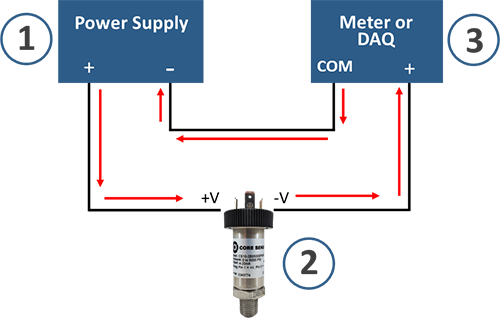
Example: Standard industrial pressure transducers are commonly specified for on-board ship monitoring applications. This includes water, fuel, and oil pressures in various systems. Core Sensors offers both standard industrial and hazardous location approved pressure transducers with pressures from 1 PSI up to 30,000 PSI. Various sensor materials and outputs can be configured for both types of pressure transducers.
Connect With Our Sales Team
Have questions? Need a quote? We are ready to help! Our team of industry and application veterans can help you navigate products, applications, and certifications for your marine requirements. Fill out the form and a member of our sales team will contact you to discuss your needs. You can also give us a call at (862) 245-2673.


